






CAC Moves to Enforce Mandatory Registration for POS Operators Nationwide, Sanction FinTechs
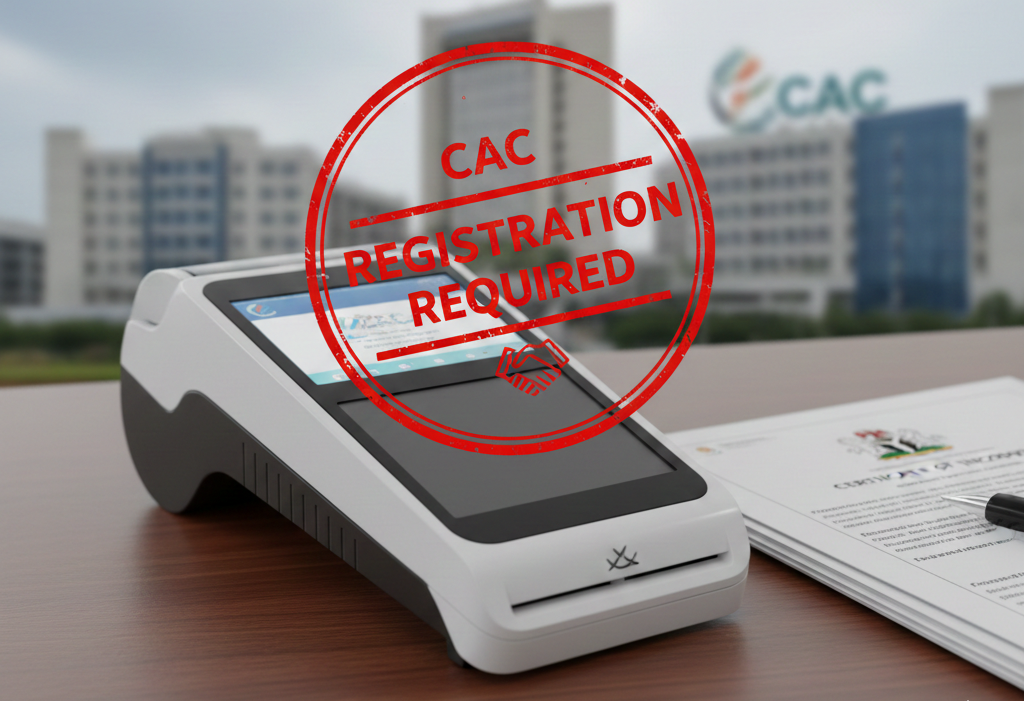
The Corporate Affairs Commission (CAC) has announced a nationwide enforcement action targeting Point-of-Sale (POS) operators and the financial technology companies (FinTechs) that power them, stating that all operators must be formally registered with the Commission by January 1, 2026.
The announcement, issued on Friday, marks a major shift from CAC’s earlier advisory and compliance-focused approach to a strict enforcement regime. According to the Commission, the proliferation of unregistered POS operators poses a growing threat to financial integrity, consumer protection, and national security.
FinTechs Placed on Watchlist
In a rare and decisive move, CAC disclosed that FinTech companies found to be enabling unregistered individuals and businesses to operate POS terminals will be placed on a regulatory watchlist and reported to the Central Bank of Nigeria (CBN) for further regulatory action.
CAC described the ongoing onboarding of unregistered POS agents as a “reckless practice” that violates the Companies and Allied Matters Act (CAMA) 2020 and contravenes CBN’s Agent Banking Guidelines.
Enforcement Begins January 1, 2026
Beginning next year, only POS operators with valid CAC registration—either as a business name or incorporated company—will be permitted to operate in Nigeria.
Non-compliant operators risk having their terminals seized, deactivated, or shut down by enforcement teams working alongside the Commission.
The enforcement phase will be supported by:
-
Security agencies
-
The Central Bank of Nigeria
-
Joint compliance task forces
CAC emphasized that POS operators were given more than a year of grace periods, extensions, and sensitization campaigns, yet compliance has remained significantly low.
Background: A Sector Under Pressure
Nigeria’s POS industry—widely hailed for driving financial inclusion—has expanded rapidly over the past few years. However, the sector faces persistent challenges, including:
-
Rising incidents of POS-related fraud
-
Terminal cloning
-
Money laundering concerns
-
Use of POS terminals for illicit transactions
-
Weak KYC and identity verification practices
In 2024, CAC mandated all POS operators to register their businesses. Deadlines were extended several times to accommodate agents who cited cost, awareness, and procedural challenges. Despite these efforts, compliance remained minimal, prompting this latest regulatory crackdown.
The move underscores CAC’s aim to bring order, transparency, and accountability to a sector that has historically operated within loosely monitored informal structures.
Reactions and Implications
The directive is expected to have immediate implications for small-scale POS operators who rely on the business as their primary source of income, particularly in rural and underserved regions.
Industry analysts warn that strict enforcement—without adequate support mechanisms—could temporarily disrupt cash access for millions of Nigerians.
For FinTech companies, the directive may require:
-
Overhauling agent-onboarding and verification processes
-
Strengthening Know-Your-Customer (KYC) systems
-
Deactivating non-compliant agents
-
Enhancing compliance and monitoring frameworks
Failure to align with CAC’s directive may expose FinTechs to sanctions and heightened regulatory scrutiny.
CAC Urges Immediate Compliance
The Commission has urged all POS operators and supporting FinTech companies to regularize their operations immediately, stressing that enforcement will be strict, coordinated, and uncompromising.



Post Comment